Oil wars since 1990, oil-dollars funding the 9/11 Terrorist Attacks, $39 trillion in Federal debt, traffic jams, and Climate Change all have the same Root Cause — Federal highways built in violation of the Constitution.
3 paths to war were rebuilt since the Federal-Aid Highway Act of 1916 started violating the Constitution:
- Taxation without Representation (American Revolution). Debt is the tax on future labor. Debt beyond 19 years repayment is a tax on the future labor of children imposed without consent. Children cannot rebel, so they will just suffer massively when debts they cannot carry collapse on them.
- Illicit Energy (American Civil War, Iraq, Afghanistan, Iran). Dependence on energy outside self-reliance from slavery and from foreign oil addiction build the same path to war.
- Transferring Wealth from the Many to the Few (French Revolution and others). Federal money printing, inflation cause those holding assets to see the value of their assets increase in value. The young and the poor, those who must trade their labor to buy assets, see the value of their labor debased. National debt and money printing increased in tandem with buying foreign oil (link).
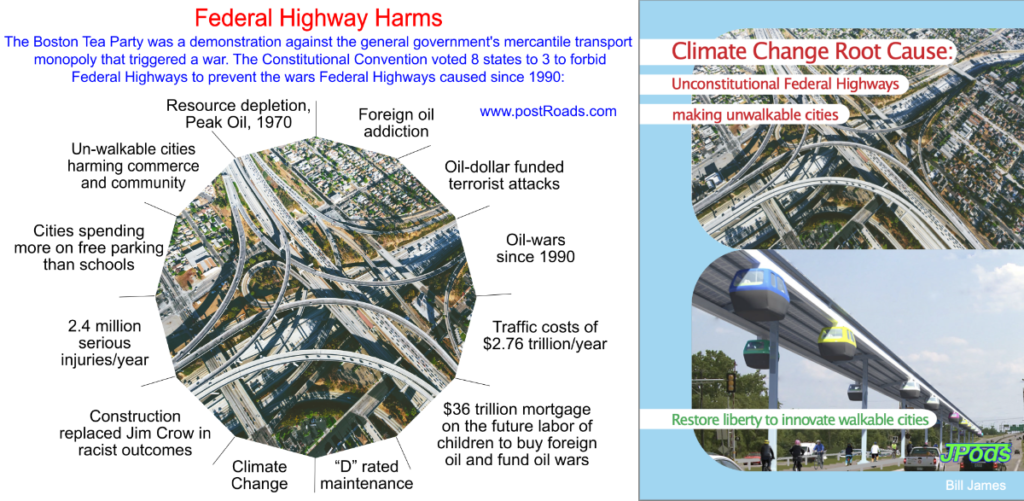
The Boston Tea Party was a demonstration against the general government’s mercantile transportation monopoly that triggered a war. To prevent rebuilding that path to war of mixing war-powers with commercial self-interests, the Constitutional Convention voted 8 states to 3 to forbid Federal taxing to provide welfare.
Madison’s Notes On the Debates in the Federal Convention, Sept 14, 1787:
- Dr. Franklin proposed to add Federal taxing powers to build canals to the “post Roads” enumerated limit on Federal “internal improvements.”
- Mr. Madison recommended it be raised to a power to form corporations to accomplish Federal objectives.
- Mr. King and Col Mason brought up the risks of “mercantile monopolies;” the Boston Tea Party has been a demonstration against the general government’s mercantile transportation monopoly.
- States voted 8 to 3 to the enumerated limit of only “post Roads,” only assuring the Federal obligation to defend free speech by delivering letters.
Madison explained this vote in Federalist #45:
“The powers delegated by the proposed Constitution to the federal government are few and defined. Those which are to remain in the State governments are numerous and indefinite. The former will be exercised principally on external objects, as war, peace, negotiation, and foreign commerce; with which last the power of taxation will, for the most part, be connected. The powers reserved to the several States will extend to all the objects which, in the ordinary course of affairs, concern the lives, liberties, and properties of the people, and the internal order, improvement, and prosperity of the State.”
Vetoes:
Once established, powerful Congressmen wanted to tax all Americans to build highways and other commercial efforts to benefit their districts (pork projects). 21 times Presidents enforced the Constitution that states are sovereign over “internal improvements.”
- President Madison, Bonus Bill veto:
- “An act to set apart and pledge certain funds for internal improvements,…pledges funds ‘for constructing roads and canals’ does not appear that the power proposed to be exercised by the bill is among the enumerated powers.”
- President Monroe, Cumberland Road veto:
- “sovereignty for all the purposes of internal improvement…is said to be derived:”First, from the right to establish post-offices and post-roads; second, from the right to declare war; third, to regulate commerce; fourth, to pay the debts and provide for the common defense and general welfare; fifth, from the power to make all laws necessary and proper for carrying into execution all the powers vested by the Constitution in the Government of the United States or in any department or officer thereof; sixth and lastly, from the power to dispose of and make all needful rules and regulations respecting the territory and other property of the United States.
- According to my judgment it can not be derived from either of those powers, nor from all of them united, and in consequence it does not exist.”
- President Jackson, Maysville Road Bill veto:
- “It does not, in my opinion, possess it; and no bill, therefore, which admits it can receive my official sanction.”
- President Tyler (1842):
- “I cannot but regard the bill as asserting the right to apply the funds and credit of the Federal Government to works of internal improvement of a local character…”
- President Polk (1847):
- “Many of the works provided for by the bill are, in my opinion, wholly local in their character, and it appears to me that the local interests which are sought to be promoted might be more appropriately, as well as more justly, provided for by the States immediately interested.”
- President Fillmore (1850):
- “I can find no authority in the Constitution for making appropriations of the public money for such purposes, and I cannot approve a bill which in my judgment violates that instrument.”
- President Pierce (1854):
- “The practice of the Government has been far from uniform on this subject, but I might refer to a large number of acts to show that the attention of Congress has been constantly turned to the local interests and convenience of certain ports…”
- President Buchanan (1859):
- “Among the powers expressly granted to Congress by the Constitution, there is no one which authorizes appropriations from the Treasury for internal improvements, for the purposes of commerce or otherwise, within the limits of a State.”
- President Buchanan, St. Clair Flats veto:
- “And Mr. Madison, in his veto message of the 3d March, 1817, declares that–’The power to regulate commerce among the several States can not include a power to construct roads and canals’ What a vast field would the exercise of this power open for jobbing and corruption!”
- President Johnson (1867):
- “The Constitution does not expressly give Congress the power to make appropriations for purposes of this kind, and I am not aware that it possesses such power unless by implication.”